Pain Education Series #3

9/6/22 Pain 3


Hello, Zeborah Dazzle, PT, WWF here — spokes-zebra and patient educator for Good Health Physical
Therapy. We have been talking about pain over the last two posts, and specifically how, in some
situations, the nervous system can become sensitized to keep pain levels stirred up. In these instances,
the nervous system itself can be as much or more of a cause of the chronic pain than any tissue damage.
When the spinal cord and brain become sensitized, this is called central sensitization. So our question is
how to calm those sensitized nervous system?


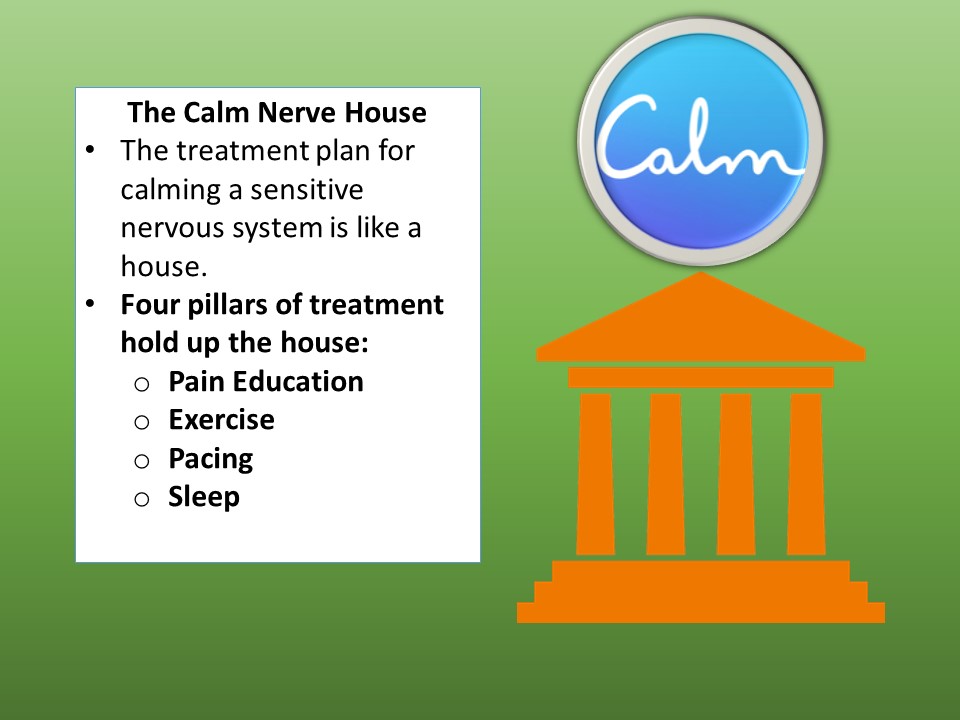
The best results in therapy often happen when multiple approaches are used in a coordinated plan. The
model we use is the Calm Nerve House and the basic pillars of the house are Pain Education, Sleep,
Exercise and Pacing. Today, let’s talk more about pain education and sleep.


PAIN EDUCATION
Recent studies have shown that pain education (just the type of thing you are getting in these posts) can
have a positive effect on pain. When patients understand what is happening in their bodies, this helps to
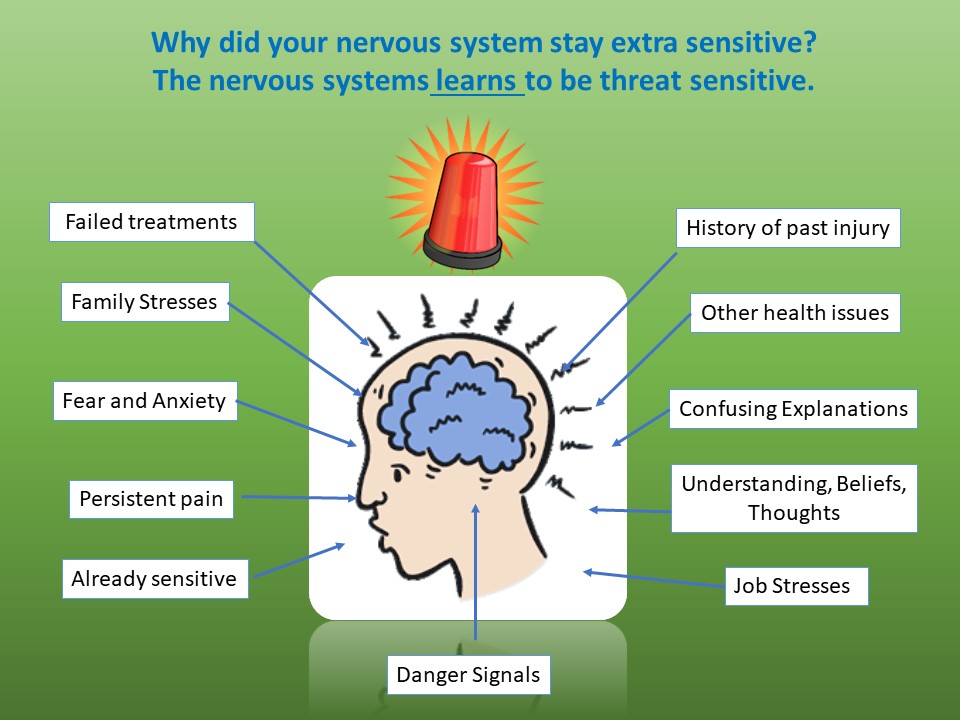
lower fear levels which in turn helps to calm the brain. Additionally, understanding the different factors
which can add together in the brain (See diagram) to sensitize the brain, can be a big help for patients
on their healing journey. For example, knowing that old emotional traumas can teach the brain to be
extra alert for potential injuries, can help guide a patient toward getting help with that trauma. And
knowledge of the other kinds of stresses which sensitize the nervous system can lead the patient to
problem solves ways to lower those stresses. Knowledge is power, especially when we use that
knowledge to guide our decisions.
SLEEP
A fatigued nervous system is a sensitive nervous system, so sleep is crucial to pain control. There is no
one perfect piece of advice to help with sleep, but below is a general list of tips.
Lifestyle
 Get regular exercise each day, preferably in the morning. There is good evidence that regular
exercise improves restful sleep and overall health. This includes stretching and aerobic exercise. Try
to limit exercise 3 hours before bedtime.
· Get plenty of sunlight outdoors, particularly later in the afternoon.
· Use the evening hours for settling down. Avoid challenging or stimulating activities and avoid bright
lights in the evening 2-3 hrs. before bedtime.
· Try to avoid naps during the day.
· Pick a regular bedtime and wakeup time and stick to them throughout the week.
· Avoid all bright screens including phones, tablets, TVs, or other tech devices 1 hour before going to
sleep.
· Once you are in bed, relax from head to toe and guide your mind to pleasant thoughts.
· Don’t command yourself to go to sleep or “clock watch”. This only makes the mind and body more
alert.
· If you lie in bed awake for more than 20-30 minutes, get up and go to a different room to do a quiet
activity. Return to bed when you feel sleepy. Do this as many times during the night as needed.
Food and Drink

 Although small snacks can help you get to sleep, don’t eat a large meal about 2 hours prior to
sleeping.
 Limit how much you drink at night to reduce your need to get up to urinate, but don’t go to bed
thirsty.
 Stop all caffeine consumption no later than 6 hours before you are planning on going to bed.
 Avoid all forms of nicotine prior to sleeping including cigarettes, chewing tobacco, and vaping.   
 Avoid drinking alcohol before bed.
Environment
 Keep your bedroom quiet, dark, and cool. Try using a sleep mask and/or earplugs to help you sleep.
 Run a fan or other steady “white noise” during the night if noises wake you up.
 Reserve the bed for sleeping, sickness or sex only. Do your reading or TV watching in another room.
 Keep your hands and feet warm. If needed, wear warm socks and/or gloves to bed.
 Wear loose-fitting nightclothes. The more comfortable you are, the better you will sleep.
 Try not to sleep with disruptive bed partners such as your children, pets, or spouses.
Until next post – Cheers!
Zebbie

Pain Education Series – #2


Hello,

My name is Zeborah Dazzle, PT, WWF, and I am the new spokes zebra and a patient educator for
Good Health Physical Therapy. I am posting some educational pices in between seeing patients, and we
have been discussing pain, especially chronic pain, which is something very familiar to those of us with
EDS and hypermobility.


I finished my last post by describing how the nervous system can become overly sensitized so that the
pain perception being created is no longer in proportion to the injury in the body. As I described, the
nervous system with the brain at the top, is the sensory and control system of the body. Pain is a perception that is the brain’s estimate that the body is being harmed. And it does not always make the
estimate accurately.


When an area of the body has been injured repeatedly, the local nerves can become overly sensitized
and send too many signals to the brain – out of proportion to the injury. This is called peripheral
sensitization. Similarly, there are connector nerve cells in the spinal cord that can get overly sensitized
and allow too many signals to pass to the brain. And finally, the brain is a learning organ and will make
it’s estimate of potential injury based on past experiences and current stresses. Sensitization of the
spinal cord and/ or the brain is called central sensitization. Practically, this means that the nervous
system itself may be as much or more of a problem than any injury to the body such as sprains, strains
or hypermobile joints.


When nerve danger signals hit the brain, they are interpreted by a number of areas of the brain working
together. If the person has a past history of being injured or of physical or emotional stressors, the brain
may over interpret the signals and create too much pain or pain over too large an area. (See the
illustration of different factors that can cause the brain to overestimate.)


How do we get the nervous system to calm down and stop blaring its warning messages (pain)?
One avenue to calm the nervous system can be medication. All medications have their pros and cons, so
we believe that it is very important that you work with your primary care provider to find the right
strategy of medications to use – even if you are just using over-the-counter medications. Now, as you
probably know, we physical therapists do not prescribe drugs though and we have some other
strategies.


It can be useful to look at non-drug approaches to calming the nervous system as being like a house: the
Calm Nerve House. All solid houses have sturdy pillars which hold them up and so does the Calm Nerve
house; while there are many healing approaches in the Calm Nerve House, the pillars are:


 Pain Education – understand your pain and how it works. Knowledge gives power. (This is what
I am working toward with these posts.)
 Sleep – a fatigued nervous system is a nervous system on edge
 Exercise – “motion is lotion”
 Pacing – too much lotion creates commotion


We will talk more in-depth about each of the pillars and some of the content of the Calm Nerve House in
coming posts.


Until next time – Cheers!, Zebbie

Welcoming our Newest Team Member – Pain Education Series – #1

Zeborah Dazzle, PT, WWF

Pain Education Series – #1
Hello,

My name is Zeborah Dazzle, PT, WWF and I am the new spokes zebra and a patient educator for
Good Health Physical Therapy. Today, I would like to talk about a topic familiar to all of us with
hypermobility or Ehlers-Danlos syndrome or any one of a number of other kinds of health problems.
Let’s talk about pain.


When I first went through PT school, the model of pain we were taught was something like a doorbell.
Some thing happens to the body, a stimulus, which sets off local nerves, like pressing the doorbell
button, and the wires carry the signal to the brain which registers pain. Ding-dong. ☹
Over the last twenty years though, science has come to recognize that pain is MUCH more complex than
this. Well, actually, not to contradict myself, pain can be as simple as the doorbell model but when it
continues, it becomes much more complex. Let me explain.


Imagine being in the kitchen barefoot (not hard for me since I am always bare hoofed). You drop a heavy
pot and it hits your foot. Ow! Your foot is bruised but not broken and it hurts. This fresh “acute” pain is
like the doorbell model. The pot hit your foot and pushed the button sending signals through the nerves
to the brain. And if your foot heals normally, the pain will fade as the healing happens and then go
away. But sometimes, even as healing happens, pain can continue. Why? Because the nervous system
has become sensitized. And then, the problem becomes more of a nervous system problem than a
bruised foot problem.


As you probably know, the nervous system is the control system for the body. Nerves big and small
reach almost every square centimeter of the body (I’m from South Africa – we think metric there). And
the nervous system is built for learning. So, when pain nerves keep firing over and over, such as if
someone hurts their foot over and over, or if the person has “connective tissue issues” as we like to say,
the nerves learn to be more sensitive. This can include the nerves in the foot, the nerves up the leg, the
spinal cord and especially the brain.


The brain is a learning organ. It is also where signals from the body are interpreted. For example, using a
different sense, your ears receive sound waves, and these are converted to nerve impulses by the
cochlea and then carried to the brain by the hearing (acoustic) nerves. Only in the brain though do the
nerve impulses get interpreted so that you can identify the laughter of a child or anger in someone’s
voice or your favorite song. Many parts of the brain get involved with this including areas that identify
sound, memory centers, areas that recognize speech and language and emotional centers. Pain works in
much this same way.


Pain is the brain’s estimate that the body is being harmed. And the brain does not always get the
estimate right. When the brain is estimating potential harm, it uses what it has already learned about
the world, and it calculates in past learning. So, if you have a history of being abused, or a history of
injuring the body area before, or you are stressed and on edge, the brains estimate is higher than what
is true to the tissues. We call this central sensitization.


I believe that most of us with hypermobility or EDS have brains which are to some degree sensitized. So,
we need to treat the nervous system in our recovery too. What the brain can learn though, it can re-
learn or unlearn. How do we help the brain? More in coming posts. Until next time – Cheers!, Zebbie.

What is the difference between Kinesio®tape and athletic tape?

Cueing vs stability
Kinesio® tape is stretchy compared to athletic and Leukotape®. Each are great and beneficial, but for very different purposes.

The stretchy quality of Kinesio® tape provides cues for better joint alignment and position, muscle activation, and posture. As your body moves into these positions, the tape will stretch, giving you a cue to reduce the tension of the tape and return to the better posture and alignment. The stretch of the tape can also be used to help lift the skin, allowing more blood flow. It has been shown to help reduce swelling and help with soft tissue healing.

Other kinds of more traditional tape are used for stabilization. Because of its less stretchy nature, athletic tape will prevent movement into poor positions all together, not allowing you to move out of a certain alignment.

How do you know if Kinesio® tape or athletic tape would be best for you?

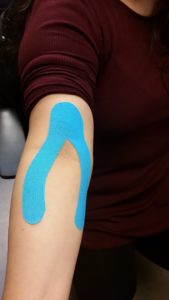
Kinesio® tape to help prevent elbow hyperextension

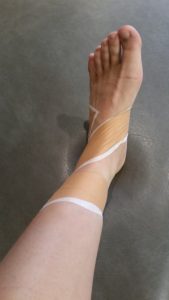
Leukotape® to keep the arch lifted and prevent twisting the ankle

The best way to know would be to see a physical therapist to assess what is happening with your posture or joint alignment. We are trained in the different techniques, patterns, and ways to cut and apply the tape to provide the best benefit and proper purpose of the tape.

For a quick answer though, if you are looking for more stability like a temporary brace, then athletic or Leukotape® are best. If you are trying to retrain yourself to use the right muscles and maintain a certain posture or alignment, then Kinesio® tape is best.


We recommend seeing a physical therapist for the other more medical applications of Kinesio® tape such as to reduce swelling or increase blood flow to an injured area for healing.

A physical therapist at Good Health Physical Therapy & Wellness is always happy to provide more information or assess your needs to reduce or prevent pain and injury

Oregon is a direct access state for physical therapy. What does this mean for you?

Many people think that you need a doctor’s referral to get specialized care. People often see their primary care physician first for any ailment, and your doctor directs you to the right specialist for further investigation and diagnosis. Recently, with rising healthcare costs and a change in physical therapy training, many states now allow direct access. This means if you have a condition involving your muscles or joints you have the right to see a physical therapist (a musculoskeletal specialist) without a referral from your doctor. This can depend on your insurance policy, however. While this is not a federal law, several states have some version of direct access. Oregon is one of them!


According to a 2016 article in the American Physical Therapy Association’s magazine, PT in Motion, Oregon is one of several states that provide unrestricted direct access. A study done by the American Physical Therapy Association has shown the same quality of care, no adverse events and lower cost for patients who saw a physical therapist through direct access compared to those who went to a primary care provider first.


Physical therapists are trained to rule in and rule out red flag signs and symptoms. If we are in doubt about a diagnosis, then we refer you back to a medical doctor to receive the appropriate care. More often, though, people see their doctor for a muscle or joint condition and are then referred to a physical therapist. Direct access allows you to skip a step, make one less appointment, save money, and go directly to the person who can treat your symptoms. You wouldn’t go to a physical therapist first for a sore throat, and you shouldn’t go to your primary care provider first for a pulled muscle.


So, if you think you have a musculoskeletal injury, see your physical therapist first! Start by calling our office (503)292-5882 and our helpful staff will get you an appointment. They can check your insurance company’s requirements/coverage or explain more about our reasonable cash pay rates.


Chie Tadaki, PT, DPT